West Palm Beach food service operations operate under continuous sub-tropical heat and humidity, which accelerates the decomposition of organic debris under prep tables, behind fryers, and inside floor drains. Facility…
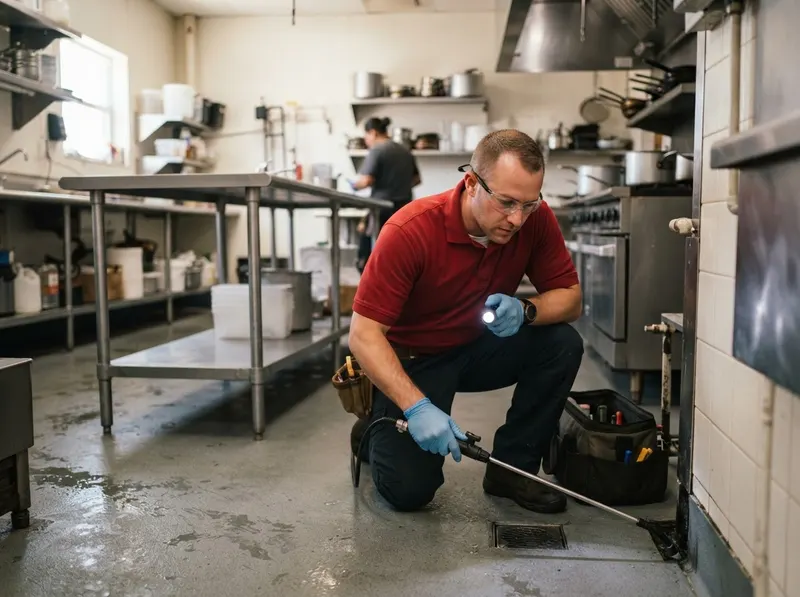
West Palm Beach food service operations operate under continuous sub-tropical heat and humidity, which accelerates the decomposition of organic debris under prep tables, behind fryers, and inside floor drains. Facility audits conducted along Clematis Street and Northwood Village frequently expose dense accumulations of grease and sugar-rich bio-sludge beneath equipment caster channels. This sludge serves as an active breeding matrix for University of Florida IFAS Extension documented vectors, including phorid flies and German cockroaches. Standard chemical spraying fails because moisture and detergent runoff wash away active residues, while leaving the nutrient-dense substrate untouched. Commercial vector sanitation addresses the structural biology of the kitchen by applying bio-enzymatic agents that consume the fat-oil-grease layer inside plumbing lines according to EPA Safer Choice standards, removing the primary survival source for crawling and flying insects.
The service sequence combines targeted mechanical cleaning with clinical-grade chemical exclusion. First, technical teams apply foaming biological cleaners to liquefy complex sugars and lipids trapped under quarry tile flooring and floor sink rims, meeting sanitation guidelines established by the FDA Food Code. Second, technicians treat expansion joints, hollow prep table legs, and motor housings using non-repellent insect growth regulators that disrupt vector molting cycles under CDC vessel and culinary sanitation benchmarks. Third, physical perimeter zones and structural plumbing penetrations receive expanding polyurethane foams and stainless mesh backing compliant with National Pest Management Association exclusion standards. Kitchens located in historic districts like El Cid and Flamingo Park frequently display shifting foundations that split floor-to-wall silicone seals, opening subterranean pest corridors that require elastomeric joint restoration.
Selecting deep vector sanitation over standard pest spraying involves direct operational trade-offs. Surface insecticides offer low initial expense but introduce odor liabilities, run the risk of food surface contamination, and require monthly reapplications as grease accumulation persists. Bio-enzymatic vector sanitation demands overnight equipment staging and access beneath low-clearance units, yet it neutralizes the micro-environment that sustains pests, significantly reducing regulatory inspection penalties under the Florida Department of Agriculture and Consumer Services. Establishments in CityPlace (Rosemary Square) and coastal corridors like SoSo (South of Southern) face elevated structural pressure from American cockroaches navigating municipal stormwater tie-ins; in these facilities, drain line remediation eliminates vector paths between main lines and prep stations. Standard service protocols can be confirmed through an on-site inspection by contacting RedOak Pest Experts at (561) 216-1463.
Every job gets a firm, written price after a free on-site visit.
For standards, safe disposal, and service guidance on pest control services in West Palm Beach, FL, useful references include U.S. EPA, ENERGY STAR, U.S. Dept. of Energy, Consumer.gov, U.S. Census Bureau, and Google Maps. General consumer and small-business resources are available from USA.gov, Better Business Bureau, FTC Consumer Advice, U.S. Small Business Administration, and Ready.gov.
Tell us about your commercial kitchen vector sanitation job in West Palm Beach and we'll send a clear, written quote, usually the same day.
 RedOak Pest Experts