Roof rat structural exclusion is engineered for properties where overhead arboreal activity threatens indoor air quality, wiring integrity, and attic insulation. In coastal Palm Beach County, Rattus rattus utilizes…
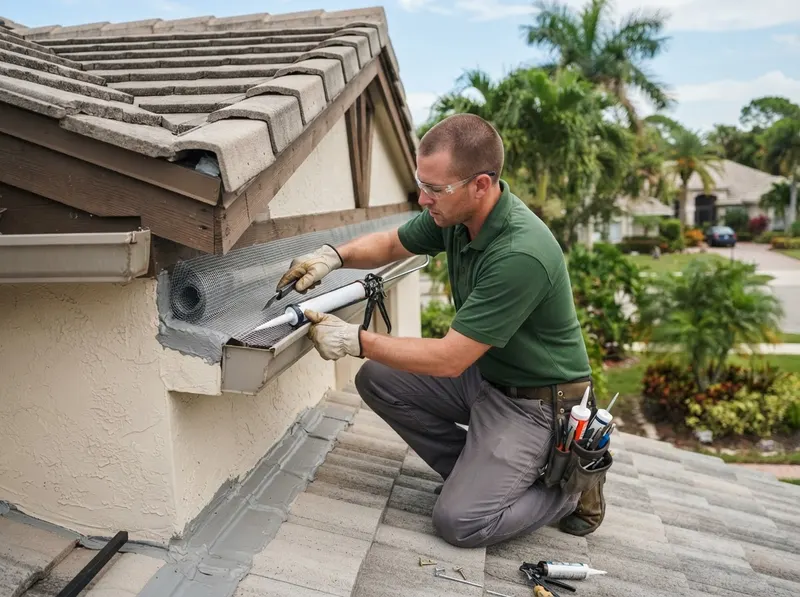
Roof rat structural exclusion is engineered for properties where overhead arboreal activity threatens indoor air quality, wiring integrity, and attic insulation. In coastal Palm Beach County, Rattus rattus utilizes tall palm canopies and continuous utility lines to access roof decks. Structural exclusion replaces continuous baiting cycles with permanent physical barriers. Unlike chemical repellents or exterior anticoagulant stations that only manage existing population surges, structural exclusion addresses the biological entry pathway directly. Properties in historic districts like El Cid, Flamingo Park, and Grandview Heights frequently feature barrel tile roofing, open frieze boards, and decorative soffit corbels that provide natural nesting cavities. If an attic displays gnawed electrical wiring, nesting paper, or localized pheromone tracking stains, physical sealing is required before interior sanitation can succeed. The structural trade-off centers on labor and material permanence versus temporary suppression: physical exclusion requires precise mechanical fastening on high pitch lines rather than simple ground-level trap placement.
Technicians map the structural perimeter by examining transitions where fascia boards intersect clay or concrete tile valleys, an area documented by the University of Florida IFAS Extension as a primary vulnerability in sub-tropical homes. Every point measuring 0.5 inches or wider, the diameter of a standard quarter, is sealed using 0.25-inch, 19-gauge ASTM International certified galvanized hardware cloth secured with corrosion-resistant screws. In newer suburban developments such as Ibis Golf & Country Club, RiverWalk, and the Villages of Palm Beach Lakes, modern barrel tile caps require custom-molded metal eave closures to close the rounded gaps under low-edge tiles. These physical barriers withstand the 24,000-pounds-per-square-inch gnawing pressure exerted by rodent incisors. Concurrently, screening over attic ventilation points aligns with standards defined by the Florida Department of Health to eliminate vectors carrying zoonotic contaminants. According to the Centers for Disease Control and Prevention, eliminating structural gaps remains the most reliable primary prevention measure against rodent-borne pathogens.
Work sequences follow a methodical, multi-phase plan: 1. Technicians survey the entire roof envelope, cataloging vent stacks, chimney chases, soffit returns, and AC refrigerant chases. 2. Heavy-gauge metal barriers and silicone-based marine adhesives are mechanically affixed over all gaps, preserving attic ventilation as outlined by the U.S. Department of Energy while denying rodent passage. 3. Overhanging foliage within 6 feet of the roof is noted for trimming, consistent with guidance from the Florida Department of Agriculture and Consumer Services regarding integrated pest management. 4. Interior mechanical traps are monitored inside the attic envelope to extract any animals stranded during exterior sealing, strictly avoiding indoor rodenticides that can cause carcass decay within wall voids. 5. Follow-up checks verify zero breach activity. Exclusion work complies with building guidelines cataloged under the Florida Building Commission, ensuring modifications protect the envelope against wind-driven rain and wind uplift verified by the Federal Emergency Management Agency. Waste disposal of soiled insulation and sanitization procedures adhere to protocols set by the U.S. Environmental Protection Agency and workplace handling benchmarks maintained by the Occupational Safety and Health Administration.
Every job gets a firm, written price after a free on-site visit.
For standards, safe disposal, and service guidance on pest control services in West Palm Beach, FL, useful references include U.S. EPA, ENERGY STAR, U.S. Dept. of Energy, Consumer.gov, U.S. Census Bureau, and Google Maps. General consumer and small-business resources are available from USA.gov, Better Business Bureau, FTC Consumer Advice, U.S. Small Business Administration, and Ready.gov.
Tell us about your roof rat structural exclusion job in West Palm Beach and we'll send a clear, written quote, usually the same day.
 RedOak Pest Experts