Subterranean termite soil treatment in West Palm Beach addresses structural threats posed by subterranean colonies, specifically the native Eastern subterranean termite ( Reticulitermes flavipes ) and the invasive…
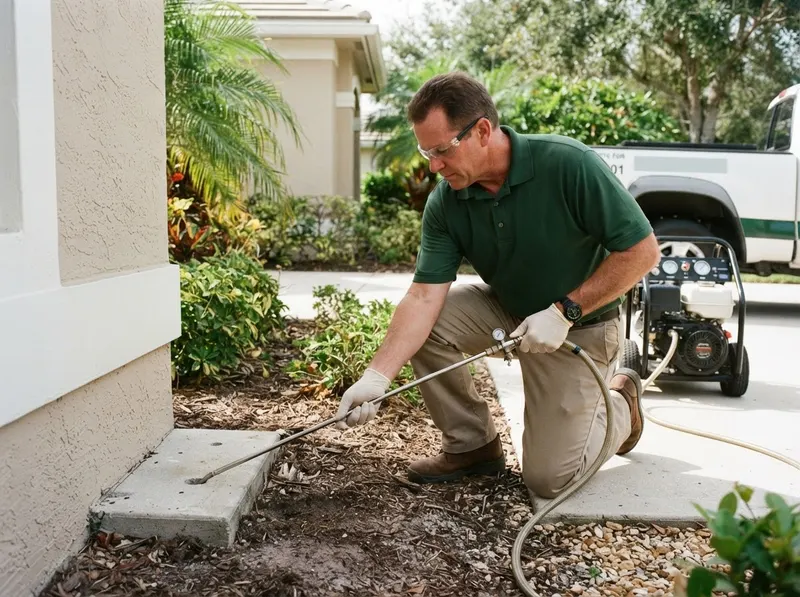
Subterranean termite soil treatment in West Palm Beach addresses structural threats posed by subterranean colonies, specifically the native Eastern subterranean termite (Reticulitermes flavipes) and the invasive Asian subterranean termite (Coptotermes gestroi). In South Florida's coastal water tables, these colonies nest underground where sand-heavy substrate provides optimal moisture. In historic crawlspace residences across El Cid and Flamingo Park, workers travel vertically inside earthen shelter tubes over masonry piers to consume damp structural wood framing. RedOak Pest Experts approaches this risk by trenching soil along perimeter stem walls and sub-slab injection at cold joints. Applying liquid barriers in sandy soils requires adherence to guidelines from the U.S. Environmental Protection Agency, saturating the subterranean substrate to an average depth of 4 feet to halt structural infiltration without aerosolizing compounds indoors.
Selecting liquid soil treatments over exterior bait matrix systems depends on structural design and pest pressure. Trenching and rodding provide immediate, continuous coverage along monorail slabs common in RiverWalk and Villages of Palm Beach Lakes, saturating the soil volume at a standard rate of 4 gallons per 10 linear feet. Conversely, localized perimeter bait stations rely on foraging intervals that can delay colony suppression during seasonal dispersal flights. The operational trade-off of a trenching installation involves short-term disruption, such as drill holes spaced at 12-inch intervals through exterior concrete pads or patio pavers in Grandview Heights. However, non-repellent active ingredients like fipronil and imidacloprid remain undetectable to workers. According to pesticide safety benchmarks from the National Pesticide Information Center, these compounds allow exposed insects to transport the toxicant back to subterranean royal chambers through grooming, collapsing the primary colony.
Environmental variables across Palm Beach County require precise barrier engineering to prevent chemical degradation. The hyper-porous shell-rich soils adjacent to the Lake Worth Lagoon in SoSo (South of Southern) permit faster downward drainage than inland clays, while the elevated baseline moisture levels near Grassy Waters Preserve and Ibis Golf & Country Club accelerate metabolic colony consumption. Treatment protocols strictly align with the Florida Department of Agriculture and Consumer Services (FDACS) rules under Florida Administrative Code Chapter 5E-2, preserving soil chemistry around structural footings. RedOak Pest Experts incorporates building biology insights from the Florida Solar Energy Center regarding slab temperature transitions and follows the University of Florida IFAS Extension protocols for non-repellent degradation schedules. All application decisions follow structural pest exclusion standards endorsed by the National Pest Management Association and structural health benchmarks from the U.S. Department of Housing and Urban Development to maintain lasting structural protection.
Every job gets a firm, written price after a free on-site visit.
For standards, safe disposal, and service guidance on pest control services in West Palm Beach, FL, useful references include U.S. EPA, ENERGY STAR, U.S. Dept. of Energy, Consumer.gov, U.S. Census Bureau, and Google Maps. General consumer and small-business resources are available from USA.gov, Better Business Bureau, FTC Consumer Advice, U.S. Small Business Administration, and Ready.gov.
Tell us about your subterranean termite soil treatment job in West Palm Beach and we'll send a clear, written quote, usually the same day.
 RedOak Pest Experts